
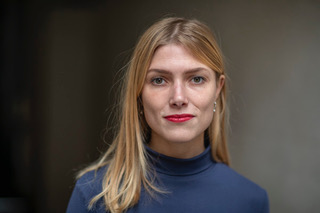
Featured Member: Clara Vlessing
Featured Member shines a spotlight on the diverse research interests of, and the exciting projects undertaken by, those affiliated with the Cultural Memory Studies Initiative. In this eighteenth instalment of the series, we speak to Clara Vlessing, an FWO MSCA Seal of Excellence postdoctoral fellow at Ghent University, whose work explores the intersections of literature, cultural memory, and social movements. In this interview, she traces the paths that led her to memory studies, reflects on her recent book, and introduces her current project on the contentious, complicated legacies of late-twentieth-century feminist figures. Along the way, she considers what CMSI has meant to her intellectually and looks ahead to her next chapter in Ireland.
Your research brings together literature, cultural memory, and social movements. What key questions drive your work, and how did these concerns first take shape?
At its most basic level, my research considers the relationship between the past and the future. I’m interested in how versions of the past press for different futures; how efforts to challenge, reshape, or reconsider what has already happened open up the present to new possibilities. More particularly, I want to understand the ways in which these dynamics play out in the cultural afterlives of politically active individuals, often, but not exclusively, in texts. How are their lives presented in different contexts and to what ends?
That’s the descriptive version of events. Prescriptively, I am also invested in how we can better use radical figures as paradigms for social transformation.
As for the ways in which these concerns first took shape… At the risk of sounding horribly cliché, I think I’ve cared about literature, memory, and movements in some way, shape, or form for as long as I can remember. Not that I was going around as a child chatting about memory studies, but I did love books and history, and was always very drawn to radical or contentious characters. So, these three strands of inquiry have been with me for a long time!
Photo credit: Clara Vlessing
At what point did memory studies become a central framework for you, and what does it allow you to see or do differently?
What happened is that in 2016 I started a masters in Comparative Literature at Utrecht University, and the course coordinator was Ann Rigney, meaning that memory studies was an essential part of my training as an academic from the beginning. In my first term I took a class where we read Marianne Hirsch, Michael Rothberg, and Stef Craps, as well as some of Ann’s own work, and then a few months later I did a masterclass that she led on memory and protest. That masterclass, as it turned out, was a sort of prototype for the Remembering Activism ERC project (2019-2024) which my PhD was part of.
As I mentioned, I was already interested in the relationship between literature and history, and cultural memory studies is an excellent framework for thinking through that relationship. The work of scholars like Ann and Astrid Erll gave me a vocabulary with which to consider the fluid or constructed nature of the past, the ways in which even the most official, fixed-seeming narrative about History comes about through iterative storytelling that takes shape across books, images, films, and all sorts of other media. Recognizing that our understanding of the past is always constructed means that you also recognize that is could be constructed differently. I like this idea. I think it is what makes the relationship between memory and social movements particularly dynamic and potentially hopeful.
I often work at the juncture of memory and life writing studies. The latter field is quite inflected by Foucauldian notions of subject formation and psychoanalysis. There’s a lot of cool work on how lives become sites of identification through which writers and readers shape their understandings of the world.
Bringing this into dialogue with cultural memory studies allows for an oscillation that connects scales, hinging between apparently individual and collective notions of the past and situating individual texts within the wider networks that give them meaning. An approach that moves between these scales enables what Jeftic, van de Putte, and Wyss call “an understanding of memory as the result of micro-interactional as well as meso-institutional and macro-cultural processes”. I thought Astrid Rasch’s recent work on Intimate Afterlives of Empire did this really well. It examines autobiographical material for how it reflects and informs the economic, political, social, and ideological forces at play in remembering lives lived during decolonization.
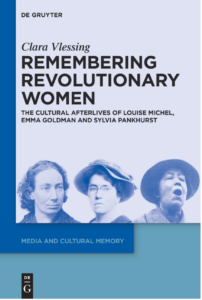
Your recent book Remembering Revolutionary Women explores the cultural afterlives of Louise Michel, Emma Goldman, and Sylvia Pankhurst. Why do these figures still matter today, and what does their continued relevance tell us about how we remember political struggle?
Yes, the electronic version of the book has just been published, and the first chapter is open access. I’m very excited about it!
Michel, Goldman, and Pankhurst were people who gave their all to revolutionary change. They defied so many of the social norms and taboos of their age in ways that were both subtle and extreme: from having a child out of wedlock or being a vegetarian, to attempting to assassinate heads of state, engaging in armed conflict, or hunger striking. They were also all deeply committed to traditions of radical thought that fundamentally guided their political struggles, in Michel’s and Goldman’s cases anarchism and in Pankhurst’s socialism and later left-wing communism.
I think they still matter today because of the all-consuming nature of their political action. These are three revolutionaries who, in different ways and with different outcomes, were pretty uncompromising in their defiance. They really risked everything.
That braveness comes up again and again in the material I draw from in the book, including in interviews that I did with biographers and memory activists. There’s often an element in this of what Enzo Traverso terms “left-wing melancholia”, a yearning for a past before the rise of neoliberalism in which there was perhaps more space for revolutionary politics. People are affectively attached to Michel, Goldman, and Pankhurst; they find them inspiring; they use these figures to imagine a time when more radical change seemed possible.
In my book I theorize “attachment” as an understudied element in memory studies and a vital force in the remembrance of revolutionary women. Of course, the afterlives of political struggle depend on much more than people’s association or identification with historical figures. Cultural memory is also the outcome of what material is available and accessible from these figures’ lives, not to mention the sort of economic and political forces that define the contexts in which they are remembered. But I think that looking at Michel, Goldman, and Pankhurst shows how central claims of likeness or connection are to the remembrance of activism.
Your monograph takes a plurimedial approach, working across texts, images, performances, and archives. What does attention to different media reveal about how memory is created and sustained?
A central idea in cultural memory studies is that memory is circulated through mediation and remediation, that, to quote Ann and Astrid, “particular media offerings become agenda-setters for collective remembrance”. Any one mediation is always produced in dialogue with carriers of memory that may well use a different sort of media. So, for instance, a biography might draw from an archive and then inspire a documentary. Cultural memory is formed in the interaction between these objects – what they repeat, reinforce, or discard – and in their convergence: taken together, they show how the reputation changes over time. From this perspective it doesn’t really make sense to only consider one form of media.
That said, it does make life easier as a researcher to limit yourself. One of the things I struggled with in the book was working out which representations of Michel, Goldman, or Pankhurst to focus on. I ended up going for what I call “longform” mediations in which some representational aspect changes – maybe a new element of one of these figures’ lives comes into view, new sources are found, or they take on a different valence. This means that my research was skewed towards narrative media like books and films.
I would like in the future to find a way of making my research even more “plurimedial”. I’m now beginning to think about a new book project that will come out of my postdoctoral work on the afterlives of feminists from the 1970s. My hope is that this next book will compare an analysis of longform media with research on more ephemeral mediations, social media posts, or protest paraphernalia. That said, I have a tendency to bite off more than I can chew… So we will have to see on that one.
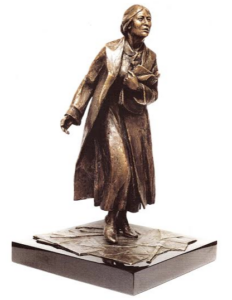
Photo credit: City of London Corporation/Handout
Is there a book, film, or artwork that captures the core concerns of your research, or that has been especially important to you recently? Why?
One of the objects that is at the heart of Remembering Revolutionary Women is a statue of Sylvia Pankhurst, or rather, the campaign to put up a statue of Sylvia Pankhurst. The campaign has been going on since 1998, and the statue itself still hasn’t gone up. It’s still sitting in the foundry where it was cast. At the moment, the organizers are waiting for planning permission, but it was a similar story when I spoke to them five or six years ago.
I keep returning to this statue as a case study for several reasons.
Firstly, because the lengthy campaign and committed memory activists demonstrate the sheer amount of time, effort, and energy that people are prepared to put into remembering Pankhurst. The campaigners are trade unionists and feminist historians who have been going for years, raising money at events up and down the UK. They really care about Pankhurst’s remembrance. The campaign is a very grassroots project with lots of support from many different people, and in that respect it’s not in keeping with the sort of top-down processes that might be expected to lead to a statue’s erection.
This leads me to the second reason I find this case interesting, which is the choice of medium. Pankhurst was a dyed-in-the-wool anti-establishment radical. At points in her life, she completely refused to engage in party politics. Are there tensions here between her beliefs and a statue as a mode of commemoration, particularly when you take into account the initial plan to place the statue outside the Houses of Parliament? I think this case raises important questions about the relationship between a remembered subject and the means of remembrance. Do radical figures require radical methods of commemoration? Does their canonization limit their radical potential?
And lastly, I think this case raises necessary methodological problems. How to study a statue that doesn’t, in any traditional sense, exist? How much weight should we give this campaign in any overview of Pankhurst’s afterlives?
There’s an article by Katrin Antweiler that I’m very drawn to in which she urges more focus on contradiction and fracture in memory studies, writing that “[c]ollective memory will never be fully inclusive nor can it be the arena in which new solidarities emerge because it is epistemologically bound to the ideal of purity”. I think developing ways of studying unfinished projects helps us tackle this ideal of purity that again seems particularly important to engage with for those of us studying activism, which is a pretty messy business. I lead a monthly reading group on memory and activism with Eline Mestdagh and Alexander Ulrich Thygesen, and how to study contradiction comes up again and again.
Alongside your work on revolutionary women, you are currently an FWO MSCA Seal of Excellence fellow at Ghent University. Can you tell us about this project, and how it builds on or diverges from your earlier research?
My current project “Feminist Provocateurs” is in some respects part two of Remembering Revolutionary Women. Rather than looking at how figures who were active in the early twentieth century have been remembered, it looks at the cultural afterlives of feminist campaigners who have been associated with the women’s liberation movement of the late twentieth century. But in the FWO project I’m much more focused on the recollection of these figures in the present and by those who identify as their political descendants. How are feminists from what has been called “the second wave” remembered today?
I think the feminism of the late twentieth century has a pretty mixed afterlife. On the one hand, there’s a lot of nostalgia for it. In a recent article in the London Review of Books, Jacqueline Rose writes about “a certain form of political faith”, characteristic of the feminism of the 1960s and ’70s, “that the world, at least partly because of the strength of political energy we were bringing to it, would never go so wrong, so terribly and utterly wrong, again”. Mention Audre Lorde to any millennial feminist worth their salt, and they (we) go a bit misty-eyed.
On the other hand, there is an understandable level of wariness about a lot of feminists from this era. When I tell friends that I’m working on Andrea Dworkin, for instance, they usually pull a bit of a face and say something like, “she’s a TERF isn’t she?” The reality with Dworkin is much more complicated; it depends on who you ask or how you read her writing. But the point here is that my friends’ initial reaction is highly circumspect. There is a long history of a sort of intergenerational struggle in feminist intellectual history – discussed in works like the brilliantly named Not My Mother’s Sister by Astrid Henry – but I think the instant disavowal of older feminists has the potential to be quite counterproductive.
My project considers the losses and gains inherent in this sort of binary recollection. What horizons of possibility does recalling earlier feminists allow for? How are they mobilized for contemporary struggles against intersecting forms of oppression?
You’ve recently been awarded an IRC Postdoctoral Research Fellowship in Ireland – congratulations! How has your time at Ghent University and your involvement with CMSI shaped your research and future collaborations?
Thanks! I’ll be going to University College Dublin in March for a two-year project and to work with Anne Mulhall and several other colleagues across the Centre for Gender, Feminisms & Sexualities. I’m looking forward to this but will miss Ghent, where I’ve met some lovely colleagues.
CMSI is a great forum for wide-ranging discussions about the future of memory studies. We’ve had fascinating conversations during my brief time here about how AI might affect our field or how to engage, as memory scholars, with the genocide in Palestine. And it has been fantastic to work alongside Stef, whose commitment to activism as a part of academic life I find really inspiring.
As for the future, along with Sofía Forchieri, I am now writing an article for a special issue of Storyworlds on memory and narratology, which is edited by UGent’s Gabriele D’Amato and CMSI’s Stefano Bellin. So, in that sense, my association with the university and with the initiative will live on.
Other than that, hopefully I’ll be back in a few years time!