Lecture: Lisa Guenther

Date: Thursday 30 April, 14:00-17:00
Location: Library Lab Magnel, Rozier, 9000 Ghent

This “meet the expert” activity consists of a masterclass session with Lisa Guenther (Queen’s University), a leading scholar in critical phenomenology. In this session, she will guide participants through a close reading of two of her key articles, offering insight into how critical phenomenology can illuminate the ways lived experience is shaped by social, political, and material structures.

Critical phenomenology is an innovative and rapidly growing research approach that examines how lived experience is shaped by social, political, and material structures such as race, gender, disability, spatial organisation, and institutional power. Increasingly used across disciplines — including philosophy, sociology, political theory, and health studies– it provides conceptual tools for analysing structural injustice as it manifests in everyday life.

By engaging directly with a key text (or texts) under the guidance of one of the field’s foremost contributors, attendees will gain insight into current debates, emerging research directions, and the societal relevance of phenomenological methods for studying inequality, marginalisation, and systemic violence. The activity aims to foster intellectual exchange across disciplines and institutions and to strengthen doctoral-level research capacity in socially engaged theory. 

Reading materials that we will discuss:

Guenther, L. (2021). Six senses of critique for critical phenomenology. Puncta, 4(2), 5-23.

Guenther, L. (2024).  Collective Memory at Canada’s Prison for Women. Critical Times, 7(2), 260-279.

Registration via: https://event.ugent.be/registration/MasterclassLisaGuenther

Or contact: lei.decappelle@ugent.be / Michiel.deproost@ugent.be

Lecture: Akira Nishimura

Date: Thursday 23 October 2025, 16:30 – 18:00
Location: Faculty Room, Faculty of Arts and Philosophy, Blandijnberg 2, 9000 Ghent

“War Memorials and Religion in Japan: Separation of Religion and Politics and the Role of the Scholars,” given by Prof. Akira Nishimura (University of Tokyo)

Abstract

While the field of memory studies has not yet been fully institutionalized in Japan, the politics of war memory has attracted sustained public and scholarly attention since the immediate postwar years. Especially since 1995—the fiftieth anniversary of the end of the war—research on war memory has expanded significantly across disciplines. In this talk, I will explore the connection between politics and religion, which has played a key role in shaping how war memories are preserved and interpreted in wartime and postwar Japan. By looking at this intersection, I hope to show how religious institutions and practices have interacted with political and personal efforts to manage and represent Japanese war remembrance.

Bio

Akira Nishimura is a professor in the Graduate School of Humanities and Sociology at the University of Tokyo. His research explores modern and contemporary Japanese religious history, especially issues related to war memory, the Nagasaki atomic bombing, and the collection and repatriation of human remains. He has served as Editor-in-Chief (2016–2018) and President (2018–2020) of the Japanese Society for Sociology of Warfare. In 2022, he co-edited the five-volume series War and Society, acting as the lead editor for Volume 5, Transforming Memory and Commemoration (In Japanese, Iwanami Shoten Publishing). Other publications related to the lecture are:

  • “The Commemoration of the War Dead in Modern Japan” in Numen, 66 (2-3), 2019.4, pp.139-162.
  • “Battlefield Pilgrimage and Performative Memory: Contained Souls of Soldiers in Sites, Ashes, and Buddha Statues,” in Memory Connection Journal,1/1, 2011.12, pp. 303-311.

CMSI Lecture: Russell Kilbourn

Event date: Tuesday 28 October 2025, 4.00 – 5.30 p.m.
Location: Faculty of Arts and Philosophy, Blandijnberg 2, Faculty Room (first floor, right above the main entrance)

“Immanent Frames: Non-Human and Posthuman(ist) Memory in Postsecular Narrative Cinema”; given by Professor Russell J. A. Kilbourn (Wilfrid Laurier University)

Abstract

This talk compares a set of films in which the human subject is de-privileged or -centred, despite narrative cinema’s historical dependence on the human face, body, and voice. Another way of talking about the postsecular era, Charles Taylor’s concept of the ‘immanent frame’—“the disenchanted worldview of the secular age” (Caruana and Cauchi 2018)—also references the literal frame that determines the filmic image, imposing formal, semantic, and ontological limits on the onscreen world, reinforcing the properly immanent status of film form, denying in its very materiality the possibility of transcendence. Reflexive and self-critical, the postsecular represents an “incredulity toward the secularist narrative” supposedly constitutive of western modernity in which the question of belief or faith has never gone away (Caruana and Cauchi 4). The postsecular frames the privileging of immanence over transcendence fundamental to many posthumanist critiques of the Humanist tradition. This talk puts the postsecular into conversation with the posthumanist critique of the Humanist philosophical legacy as it manifests in select films that explore the convergence of memory and the question of the human.

Transhumanist deference to a technologically augmented or artificial memory must be measured against the idea of an always already technically supported ‘natural’ memory. Arguably, memory has always been posthuman because it has always had a technological or prosthetic dimension. The distinction is between a posthuman memory symptomatic of the transformation of the human subject’s cognitive and emotional relation to time, and a posthuman-ist memory that comes after the human: after the time of the human, when ‘we’ are no longer here. ‘Posthuman memory’ is still human memory, whereas ‘posthumanist memory’ is memory no longer understood in (purely) humanist terms, as something belonging wholly to ‘man’. To take account of the future of memory in a posthumanist context is to acknowledge that there is another kind of memory that demands to be thought in a post-anthropomorphic context, challenging us to conceive of a nonhuman, radically other, agent of memory/remembering. The most urgent question is: Who/what does the remembering, in the time of the posthuman?

Films include: L’avventura (Michelangelo Antonioni 1959); Le Quattro Volte (2010, Michelangelo Frammartino); Upstream Color (2013, Shane Carruth); Annihilation (Alex Garland 2018).

Bio

Russell J. A. Kilbourn is Professor of English and Film Studies at Wilfrid Laurier University. His books include: Feminist Posthumanism in Contemporary Science Fiction Film and Media: From Annihilation to High Life and Beyond (Bloomsbury, 2023); The Cinema of Paolo Sorrentino: Commitment to Style (Columbia UP, 2020); W. G. Sebald’s Postsecular Redemption: Catastrophe with Spectator (Northwestern UP, 2018); The Memory Effect: The Remediation of Memory in Literature and Film (co-ed. Eleanor Ty; WLU Press, 2013); Cinema, Memory, Modernity: The Representation of Memory from the Art Film to Transnational Cinema (Routledge, 2010). Forthcoming publications include Framing Ferrante: Adaptation and Intermediality from Troubling Love to The Lying Life of Adults (co-ed. Roberta Cauchi-Santoro; La Società Editrice Fiorentina, Fall 2025) and a special issue of Quaderni d’Italianistica on Critical Posthumanism in Italian Cinema and Media Studies.

All are welcome. Admission is free, and registration is not required. For more information, please contact Stef Craps.

Mnemonics 2025 Public Events on Memory & Responsibility

The thirteenth edition of the Mnemonics summer school will be hosted by the Flemish Memory Studies Network (a collaboration of memory scholars at Ghent University and KU Leuven) and will be held in person in Ghent, Belgium, from Wednesday 10 September 2025 to Friday 12 September 2025.

Full programme available here.

Paper presentation sessions are open to summer school participants only, but the opening event and the keynote lectures are open to the general public upon registration.


Opening Roundtable: Practising Memory in Times of Crisis

Memory is not a static record of the past but a dynamic process, constantly reshaped by present-day concerns, power structures, and competing interests. How we remember is determined as much by contemporary realities as by historical events. Responsibility, on the other hand, signifies the obligation to answer for actions, inactions, decisions, and narratives—whether as individuals, groups, or societies.

Since the late 1900s, the notion of a “duty to remember” has increasingly shaped public relations to the past. Originally tied to the commemoration of the First World War in Western Europe (“lest we forget”), the moral imperative to bear witness and prevent future horrors (“never again”) gained widespread prominence in the second half of the twentieth century in response to the Holocaust and political transitions in Latin America.

Today, this moral imperative finds itself in a profound crisis as the memory of the Holocaust is being instrumentalized by Israel and its allies to justify the ongoing crimes against humanity, ethnic cleansing and genocide in Palestine. Those who, in solidarity with Palestinian lives and in response to these acts of destruction and erasure, claim that “never again” means “never again for anyone” are silenced and accused of antisemitism.

During this roundtable, we explore the connection between memory and responsibility – the central topic of the Mnemonics Summer School 2025 – in relation to the genocide in Gaza on the one hand, and the shrinking space for civil society and activism due to a global authoritarian backlash on the other.

This conversation between memory scholars, artists, and activists will address questions such as:

  • How to explain and prevent the weaponization of memories of past atrocities to justify present-day human rights violations?
  • What is the role of memory activism in cultivating memory practices that embrace structural responsibility and foster global solidarity?
  • How to dignify victims while at the same time integrating the complex memory of complicity and implication?
  • What can be the role of academics, artists and activists in practicising memory in times of crisis?

Panellists:

  • Amani El Haddad (Gents Kunstenoverleg)
  • Manoeuvre vzw
  • Pieter Lagrou (ULB)
  • Ann Rigney (Utrecht University)
  • Michael Rothberg (UCLA)

Moderator: Eva Willems (UGent)

Date and time: Tuesday 9 September 2025, 18:45–20:30

Venue: Atrium, Faculty Library of Arts and Philosophy, Rozier 44, 9000 Ghent

Register here

Keynote Lecture Carlos Fonseca: “Theatres of Memory: From Testimonio to the Forensic Paradigm”

This talk explores the shift in Latin American cultural production from the testimonial mode of the 1980s to a contemporary forensic paradigm, examining how this transformation reconfigures the way historical memory is conceived and narrated in the wake of dictatorship, civil war, and structural violence. While testimonio once cantered the voice of the human witness as a vehicle for truth and political urgency, contemporary works increasingly turn to the material remnants of atrocity—bones, documents, ruins, archives—as privileged sources of historical meaning. Drawing on thinkers such as Giorgio Agamben, Cristina Rivera Garza, Eyal Weizman, and Jacques Derrida, the talk argues that forensics emerges as a new cultural and epistemological modality: one that displaces humanist memory with posthuman remnants. Through an analysis of contemporary Latin American novels, films, and art pieces, the talk will examine how forensic fictions perform acts of exhumation, recontextualization, and narrative assembly. These works do not simply remember the past—they stage memory as an investigative practice, where the archive no longer signals foundational truth but instead operates as a fractured, ruinous terrain through which historical sense must be laboriously reconstructed.

Carlos Fonseca Suárez is a Puerto Rica-Costa Rican writer and scholar whose work explores the intersections of literature, history, and memory in Latin America. He is the author of three novels—Coronel Lágrimas, Museo animal, and Austral—as well as the critical monograph The Literature of Catastrophe: Nature, Disaster and Revolution in Latin America. In 2021, he was selected by Granta Magazine as one of their Best Young Spanish-Language Novelists. He was also chosen by Encyclopædia Britannica as part of their Young Shapers of the Future 20 Under 40 Initiative, as one of the top twenty young international authors. In 2024, he was awarded the Anna Seghers Prize in Germany. He holds a PhD from Princeton University and is currently a Fellow at Trinity College, Cambridge, where he teaches Latin American literature and cultural theory. His recent research focuses on forensic aesthetics, postdictatorial fiction, and the material afterlives of memory in contemporary art and literature.

Date and time: Wednesday 10 September 2025, 09:45–11:00

Venue: Teresazaal, Het Rustpunt, Burgstraat 110/116, 9000 Ghent

Register here


Keynote Lecture Sara Dybris McQuaid: “Relocating Responsibility: Administrations of Memory in the Vernacular”

The term “administrations of memory” was originally coined to engage with memorialization from a governance perspective: to direct attention to the many composite ways in which memory becomes part of public policy and how particular policy processes co-produce effects and feedback far beyond representations of the past (McQuaid and Gensburger 2018, and forthcoming 2026). It goes without saying that questions of responsibility are also defined and redistributed in these generative processes.

In this talk, I will first introduce “administrations of memory” as a sensitizing concept, encouraging new ways to take on questions of memory and responsibility together. I will then use the transitional context of Northern Ireland to illustrate how transnational administrations, often fundamental to peace processes, are assembled and diffused on the ground. I will focus on a hyper-local case study in North Belfast, a former Carnegie Library, as a place where international, national and local peacebuilding agendas, regeneration policies and welfare provisions converge and diverge over time. The case illustrates the incremental disappearance of both responsibility and memory, when critical social infrastructures, such as libraries and youth services, are gradually decoupled from political authority and administration. Daylighting the blind spots produced by administrative retreat or redrawing of administrative boundaries then becomes a question of methodological responsibility for researchers: finding ways to piece together that which has been lost in transition. This is not merely a recuperative task but speaks directly to being able to grapple with more complex temporalities in transition and the different ways in which local spaces are incorporated in—and forgotten by—administrations of memory. In other words, a local approach can help “vernacularize” administrations of memory to show the different pathways through which particular spaces are drawn together in communities of memory and policy. This in turn opens up wider questions of reordering experience and relocating responsibility in ongoing peace processes.

Sara Dybris McQuaid is an associate professor at Aarhus University. She is a contemporary historian and political scientist who works mostly across the interdisciplinary fields of peace and conflict studies and memory studies. Her research pivots around how collectives remember, forget and archive their past, particularly as part of conflict and peacebuilding processes and in the context of the “post-conflict” period in Northern Ireland. She is currently on a “Carlsberg Monograph Fellowship” working on a book entitled Administrations of Memory and the Politics of the “Post-”: Northern Ireland 1994-2024. She teaches on the BA in Humanities and Conflict and the MA in Intercultural Studies at Aarhus University. She is a founding member of the Centre for Resolution of International Conflicts at the University of Copenhagen and was a co-director of the working group “Transformations of Conflict” in the COST Action “Slow Memory: Transformative Practices for Times of Uneven and Accelerating Change” from 2021 to 2024.

Date and time: Thursday 11 September 2025, 14:00–15:15

Venue: Teresazaal, Het Rustpunt, Burgstraat 110/116, 9000 Ghent

Register here


Keynote Lecture Hanna Meretoja: “Memory as Interpretation: The Approach of Narrative Hermeneutics”

This talk articulates how narrative hermeneutics approaches memory as an interpretative activity and practice. After a brief overview of how the phenomenological-hermeneutic tradition of philosophy theorizes interpretation (“something as something”), I focus on how narrative hermeneutics conceptualizes narrative and memory as interpretative practices that are entangled with one another. Memory understood in terms of acts of interpretation is, to a large extent, narratively mediated, and it is hence important to understand how cultural narratives as models of sense-making function as vehicles of interpretation that participate in constituting mnemonic acts of interpretation.

Remembering is an activity that takes place in the present and is entwined with a narrative process of meaning-making that raises issues of collective responsibility. The process of reinterpreting the past is entangled with the process of constructing and negotiating our narrative identities in the present, that is, our storied sense of who we are, and this process necessarily has a futural dimension. It is part and parcel of refiguring who we are and who we want to be—as individuals and communities—and what lessons we choose to draw from the violent legacies that precede us.

This talk suggests that narrative hermeneutics offers resources for acknowledging the role of cultural narratives as sense-making models in mediating mnemonic acts of interpretation and for discussing issues of collective responsibility. It enables an analysis of how mnemonic acts participate in reinforcing and questioning culturally dominant ways of talking about the past in ways that are relevant for how we orient ourselves in the present and towards different futures. I suggest that one important way of taking responsibility for past histories of violence is to reflect on the implicit narratives we use and on how they may perpetuate structural violence and injustice. Through a brief discussion of the themes of memory, agency, and responsibility in Jenny Erpenbeck’s novel Heimsuchung (2008, Visitation), I elucidate how narrative fiction can provide valuable interpretative resources for such reflection.

Hanna Meretoja is Professor of Comparative Literature and Director of SELMA: Centre for the Study of Storytelling, Experientiality, and Memory at the University of Turku (Finland). She runs the projects “Counter-Narratives of Cancer: Shaping Narrative Agency” (Research Council of Finland, 2023-2027) and “Narrative Agency Reading Group Model: Applications for Libraries, Schools, and Hospitals” (Research Council of Finland, 2025-2026). Her research is mainly in the fields of narrative studies, memory studies, and health humanities. Her monographs include The Ethics of Storytelling: Narrative Hermeneutics, History, and the Possible (Oxford UP, 2018) and The Narrative Turn in Fiction and Theory (Palgrave Macmillan, 2014), and she has co-edited The Use and Abuse of Stories: New Directions in Narrative Hermeneutics (Oxford UP, 2023), The Routledge Companion to Literature and Trauma (2020), Storytelling and Ethics: Literature, Visual Arts and the Power of Narrative (Routledge, 2018), and special issues of Memory Studies (“Cultural Memorial Forms,” 2021) and Poetics Today (“Critical Approaches to the Storytelling Boom,” 2022)

Date and time: Friday 12 September 2025, 09:00–10:15

Venue: Teresazaal, Het Rustpunt, Burgstraat 110/116, 9000 Ghent

Register here


Sponsored by the Doctoral Schools of Ghent University and KU Leuven, with the support of the Flemish Government, as well as by Ghent University’s Department of Literary Studies and Faculty of Arts and Philosophy.


Lecture: Emmanuel Akwasi Adu-Ampong

Ghent University’s Master of African Studies opens the academic year with a lecture by Prof. Emmanuel Akwasi Adu-Ampong (Wageningen University), “Frictions of Space and Embodied Absences: Tourism’s Intersection with Slavery and Colonial Heritage Memories.” The event is open to all, with no registration required.

Click here for more information.

Lecture: Meet the PhD-Jury: Prof. Didier Gondola

Speaker: Prof. Didier Gondola (Johns Hopkins University)

Title: Provenance & Restitution: AfricaMuseum & Its Colonial Legacy

Date: Friday, 20 June 2025

Time: 12:30 p.m. – 1:30 p.m.

Location: Auditorium P Jozef Plateau, Rozier (Ghent).


Abstract: In 2018, the AfricaMuseum in Tervuren, Belgium – one of Europe’s oldest and most prominent ethnographic museums – reopened its doors after five years of extensive renovation, aiming to shed its colonial legacy and embrace a more critical, decolonial narrative. This ambitious makeover, however, has been met with skepticism and criticism from various quarters, including activists, scholars, and even some members of the Museum’s own staff. They argue that, despite its makeover, AfricaMuseum continues to grapple with the deep-rooted structures of its colonial past.  Having engaged with this project not as an art historian but as a historian grounded in traditional archival research, I offer here a critical reflection on the provenance of the Museum’s African collections. This examination goes beyond the aesthetics of display to interrogate the historical conditions under which these objects were acquired. By tracing their often-contentious origins, I highlight the enduring power dynamics that continue to shape the Museum’s relationship with African communities.  Finally, I explore potential avenues for restitution, considering not only the return of physical objects but also the broader implications of epistemological and cultural repatriation. In doing so, I seek to contribute to the ongoing conversation about how museums can move beyond cosmetic change to embrace genuine decolonial transformation.


Bio: Didier Gondola is a historian and professor at Johns Hopkins University whose work explores popular culture, youth, masculinities, and postcolonial politics in Central Africa and the African diaspora in France. He is the author of Matswa vivant (2021), a landmark biography of Congolese anticolonial activist André Grenard Matswa, and Tropical Cowboys(2016), which examines youth culture and masculinity in colonial Kinshasa. His earlier work, Africanisme: La crise d’une illusion (2007), critically interrogates the ties between African studies in France and French neocolonial policies. Gondola is also co-editor of Frenchness and the African Diaspora (2009), and his current research focuses on restitution debates and museum collections in Belgium and France.


Lecture by Prof. Alexis Shotwell (Carleton University): “The Social Organization of Forgetting, AIDS Activism, and Resistant Relational Remembering”

“The Social Organization of Forgetting, AIDS Activism, and Resistant Relational Remembering”

Prof. Alexis Shotwell (Carleton University)

Tuesday 13 May 2025, 4.00 p.m. – 5.30 p.m.
Faculty Room, Faculty of Arts and Philosophy, Blandijnberg 2, 9000 Ghent

Abstract: Social movement scholar Gary Kinsman forwards the idea that in queer liberation movements a “passion for remembering our resistance can be a very useful antidote to the social organization of forgetting.” In this paper, I put Kinsman’s imperative to resist the “social organization of forgetting” into conversation with philosopher Sue Campbell’s work on memory as a relational and co-constituted achievement. I take the example of remembering AIDS activism in the Canadian context. Against prevailing narratives of Canadian AIDS activists as basically polite, civil actors, I discuss the ways our findings in the AIDS Activist History Project illuminate a fractious, confrontational collective context through which people made history. I argue that especially in the early years of AIDS activism, remembering queer resistance of the past functioned as a powerful relational thread for working with and through unfinished trauma in order to co-create a world in which people living with AIDS had a future.

Bio: Alexis Shotwell’s work focuses on complexity, complicity, and collective transformation. A professor at Carleton University, on unceded Algonquin land, she is a co-investigator for the AIDS Activist History Project (aidsactivisthistory.ca) and the author of Knowing Otherwise: Race, Gender, and Implicit Understanding and Against Purity: Living Ethically in Compromised Times.

CMSI Lecture: Giacomo Lichtner

Speaker: Professor Giacomo Lichtner (Victoria University of Wellington)

Title: Voices from the Threshold: Cinematic Aesthetics of the Gas Chambers and the Search for Meaning.

Event date and time: Tuesday 29 October 2024, 4.00 p.m. – 5.30 p.m.
Location: Faculteitsraadzaal (05.03.110.009), Blandijn Faculty of Arts and Philosophy, Blandijnberg 2, 9000 Gent

[The room is located on the first floor after taking the stairs in front of the main entrance]


Abstract: While cinematic representations of the Holocaust have dramatically changed in content and form since the Army Film Unit cameras entered the camps in 1945, they continue to rotate around an endless ‘search for meaning’. While survivors have consistently seen that search with suspicion, it remains topical because it speaks to fundamental historical and philosophical questions about whether or not the Holocaust can be explained, imagined, represented, and – crucially for modern remembrance and education – to what wider lessons might be drawn from it.

Within this context, this paper considers cinematic representations of the gas chambers, as perhaps the most elusive, ethically fraught aspect of the Holocaust experience. Although millions of Holocaust victims were murdered elsewhere, in fields, forests and ghettos, the gas chamber immediately emerged as paradigmatic: a site that is both the centre of the genocide and its least relatable passage. Analysing multiple perspectives and attempts, from Marvin Chomsky’s 1978 mini-series Holocaust to Lajos Koltai’s Son of Saul (2015), this paper reflects in particular on the recurrent trope of the threshold, intended both as a physical and a symbolic liminal space: a double-edged boundary used to evoke the lost on the one hand, and to titillate audiences on the other.

Long considered taboo, gas chamber sequences push the boundaries of the representable, inhabit the tension between the ‘uniqueness’ of the Holocaust and its ‘universality’. They are part of the debris left by the collision between most survivors’ refusal of explanatory frameworks and filmmakers’ fascination with (and audiences’ thirst for) ‘meaning’, and with it catharsis, closure, and relevance.

Bio: Giacomo Lichtner is Associate Professor of History and Film at Victoria University of Wellington, where he was also Associate Dean of the Faculty of Humanities and Social Sciences between 2016 and 2024. Giacomo’s research focuses on the ‘long Second World War’, the Holocaust, and on the politics of its commemoration and representation. Alongside numerous essays, Giacomo is the author of Film and the Shoah in France and Italy (2008, 2015) and Fascism in Italian Cinema Since 1945: the Politics and Aesthetics of Memory (2013). His latest projects are a monograph entitled The Search for Meaning in Holocaust Cinema (Bloomsbury), and (with Sarah P. Hill) an investigation into recent Italian interventions on physical remnants of fascism and imperialism, funded by the Australasian Centre for Italian Studies. Giacomo is Deputy Chair of the Holocaust Centre of New Zealand, and regularly advises governmental and non-governmental partners on Holocaust education and commemoration initiatives.

Giacomo is currently working on two research projects related to Holocaust cinema and Fascist material heritage:

  1. The Search for Meaning in Holocaust Cinema 
    Setting out from the tension between Holocaust survivors’ suspicion of explanatory frameworks and Holocaust cinema’s obsession with explanation and applicability, The Search for Meaning in Holocaust Cinema is a study of post-war cinema’s efforts to represent the Holocaust and to apportion meaning to the dehumanising and genocidal processes that defined it. The book isolates essential questions about Holocaust history and evaluates critically post-war efforts to represent them in the cinema, proposing a thematic, longue-durée reading of Holocaust cinema’s fraught search for moral and historical meaning. With the search for meaning as its conceptual thread, the book investigates how cinema has represented dehumanisation, mass murder, the emotional ambivalence of liberation, the traumatic legacies of persecution, and other aspects of the history of the Holocaust. The study brings to the surface and traces the contours of a foundational faultline in Holocaust history, that separates yet binds together Holocaust history and any form of Holocaust representation, and that dates back to the first questions raised at the liberation: how does one convey what happened? What – if anything – is best left untold? How can one give a voice to those who did not return, or returned voiceless and does one have the ethical right to do so?
  2. Reframing, Revisiting or Removing: Making Fascism Visible in Contemporary Italy
    Debates in Italy on the physical remnants of fascism and imperialism that have intermittently surfaced in recent decades have been reinvigorated over the past couple of years in the context of international controversies over the fate of monuments to discredited figures and ideologies. In Italy, such controversies have historically not resulted in a concerted strategy to deal with painful memories, as public opinion moved on, marginalised the challenges, or coalesced around a deliberately ambiguous or short-term response.
    The response (and lack of response) to the monuments, statues, landmarks or street names that reference or even celebrate Italy’s fascist and imperial past, demonstrates how hard it is for the country to separate the management of its fascist legacies from wider discourses on the nation’s history, where group memories, identities and politics intersect. The project will investigate this nexus.

Lezing “Et le Congo créa la littérature” door schrijver In Koli Jean Bofane

Speaker:  In Koli Jean Bofane 
Title: Et le Congo créa la littérature


Date:  11 maart 2024
Location: UGent, Blandijn, 1e verdiep


In deze lezing onderzoekt schrijver In Koli Jean Bofane (Mbandaka, 1954) de manier waarop Congo’s traumatische geschiedenis de Afrikaanse literatuur en Bofane’s eigen schrijfstijl heeft beïnvloed. Aan de hand van een aantal vragen aan zichzelf en aan de lezer, gaat hij na hoe vandaag een dekolonisatie van de verbeelding kan tot stand komen.
De lezing vindt plaats op maandag 11 maart 2024 om 19u in de Faculteitsraadzaal (UGent, Blandijn, 1e verdiep).


Registration: https://event.ugent.be/registration/event/658e3169-a4a1-4f8a-b43d-f85b36bc667b


CMSI Lecture – Sraddha Shivani Rajkomar

Speaker: Dr Sraddha Shivani Rajkomar (University of Mauritius)
Title: Translating Trauma, (Re)writing Memory: Mauritius and the Indenture Narrative

Event date and time: Wednesday 19 June 2024, 4.30 p.m. – 6.00 p.m.
Location: Camelot meeting room (3.30), Faculty of Arts and Philosophy, Blandijnberg 2, 9000 Gent

Abstract: Suppliers of its largest workforce to colonized Mauritius for over a century, slavery and indenture were characterized by structural violence. This violence was physical, psychological (Rajkomar, 2018), and discursive, marked by misrepresentations, gaps, and the suppression and destruction of archival material marring postcolonial attempts at memorialization and pointing to ‘imperial durabilities in our times’ (Ann Laura Stoler, 2016). Consequently, the Mauritius Truth and Justice Commission Report (2011) called, amongst others, for ongoing research on the unearthing and safeguarding of slave and indenture memory across media forms. To that end, I set out to translate the novel Gandhiji Bole The (‘What Gandhiji Said’) by celebrated Indo-Mauritian writer Abhimanyu Unnuth. Published in Hindi in 1984, the novel is set in early-twentieth-century Mauritius. It pools from oral family history, historiography, and Unnuth’s personal experience of working in sugarcane fields to portray what I identify as the intergenerationality of indenture trauma, and to remember MK Gandhi’s role in the economic and political progress of Indian indentured labourers.

My talk highlights key features of this intergenerational trauma in and through my English translation of Gandhiji Bole The. I am especially drawn to the figure of the child – a classic trope of narratives functioning as myth of origins – that falls sick after witnessing a scene of murder, and later goes on to access education and become the leader of the labourers’ union. This child, I argue, holds symbolical potential as representative of descendants of indentured labourers who are confronted with suppressed memories of trauma exploding onto the centre stage. The child allows reflection on a trauma extending to Unnuth at the meta-narrative level and beyond. I explore its symbolical potential through my own multi-layered positionality as a descendant of indenture using English, the former imperialist language, to mediate between past and present as translator (re)writing Unnuth’s memorialization of indenture as traumatic, and as a postcolonialist teaching indenture narratives to younger generations of Indo-Mauritians in the classroom context. It is a self-reflective exercise that, furthermore, probes into the contribution to postcolonial trauma theory of studying the affective dimension of translating the traumatic experiences of those who in turn come to stand for one’s ancestors.

Bio: Sraddha Shivani Rajkomar joined the University of Mauritius as Lecturer in English and Cultural Studies after completing her undergraduate and postgraduate studies at the University of Leeds. Her research interests include postcolonial, islandand diasporic histories, cultures and literatures; trauma and memory studies; the sacred; creolisation and Orientalism. She is the translator of What Gandhiji Said (working title; forthcoming), originally written in Hindi by Mauritian writer Abhimanyu Unnuth. For this project, she received funding from the Mauritius Research and Innovation Council (MRIC).

Contact: s.rajkomar@uom.ac.mu

CMSI Lecture – Rebekah Vince

Speaker: Dr Rebekah Vince (Queen Mary, University of London) 
Title: The Shoah in Postcolonial Perspective: Etty Hillesum and her Moroccan Secret Sharer

Event date and time: Tuesday 21 May 2024, 4.30 p.m. – 6.00 p.m.
Location: Camelot meeting room (3.30), Faculty of Arts and Philosophy, Blandijnberg 2, 9000 Gent

Abstract: In recent years, there has been a growing recognition of the interconnectedness of Jewish studies and postcolonial studies, particularly when it comes to questions of diaspora, memory, and trauma. Inherent to Edward Said’s conceptualisation of Orientalism is the ‘secret sharer’ of Western antisemitism. Such secret sharing was brought to the fore recently in the Netherlands when Dutch-Jewish author Arnon Grunberg declared in his Remembrance Day speech on 4 May 2020 that ‘if you’re speaking about Moroccans, then you’re speaking about me’. In a similar act of solidarity, in her novel Les Attentives [The Attentive Ones] (2014), French-Algerian Muslim author Karima Berger enters into sisterly dialogue with Russian-Dutch Jewish confessional writer Etty Hillesum through her wartime diaries, and more specifically the figure of a Moroccan girl who features within them. The dialogic novel reveals how Jews and Muslims are ‘secret sharers’, in their differentiated though intersecting experiences of colonisation, Orientalism, secularisation, antisemitism, and Islamophobia. In this way, it embodies memory studies scholar Michael Rothberg’s notion of ‘differentiated solidarity’ (2011), while also revealing how Etty Hillesum inspired the monks of Tibhirine in Algeria, near to Karima Berger’s birthplace. Such sisterly solidarity is exemplified by contemporary peace activists Dina Awwad-Srour and Emma Sham-Ba Ayalon, a Palestinian and an Israeli, who created the ‘Etty Hillesum Cards’ in 2019 to promote a humanist response of global healing in the face of trauma. (You can watch the film here.)

Bio: Rebekah Vince is a Lecturer in French at Queen Mary, University of London. She is a memory studies scholar specialising in French postmemory narratives, francophone postcolonial studies, and the Mediterranean francosphère. In 2018, she received a Wolfson-funded PhD from the University of Warwick, focusing on the Israeli-Palestinian conflict as depicted in literary texts by francophone North African authors. Her research moves at the intersection between postcolonial studies, Jewish studies, and transnational French studies, engaging with dialogic approaches to memory. Her monograph, tentatively entitled Unsettled Memories: Franco-Maghrebi Literature on the Israeli-Palestinian Conflict, is under contract with Liverpool University Press.

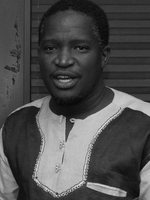
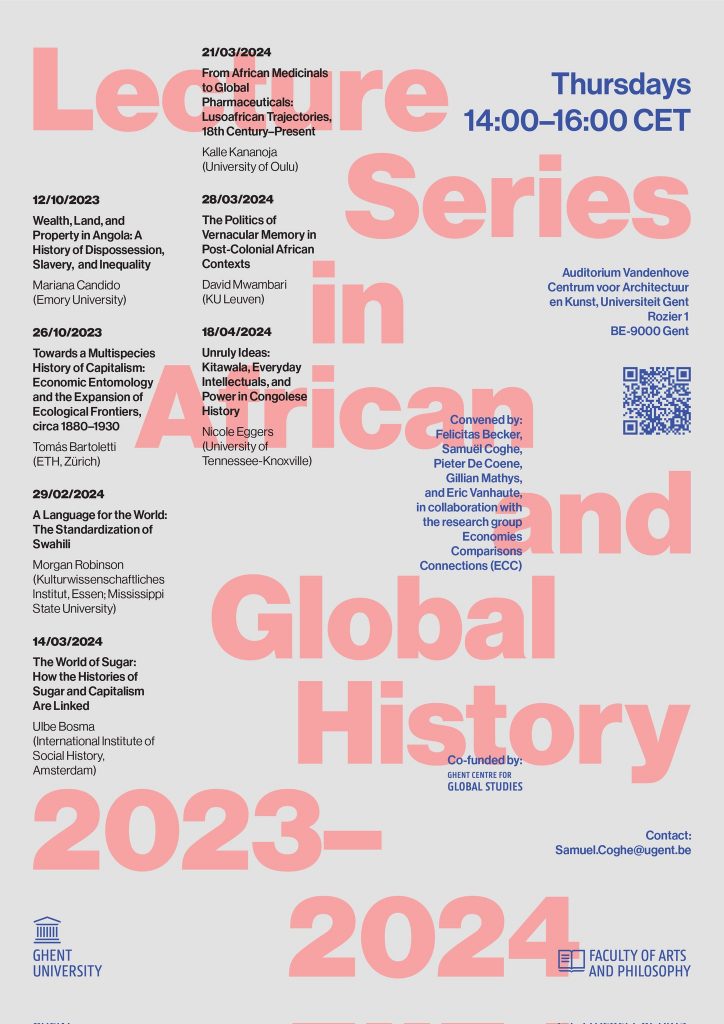
Lecture Series in African and Global History: David Mwambari

Speaker: Professor David Mwambari (KU Leuven)
Title: The Politics of Vernacular Memory in Post-Colonial African Contexts

Part of the 2023-2024 Lecture Series in African and Global History at Ghent University, convened by Felicitas Becker, Samuel Coghe, Pieter De Coene, Gillian Mathys, and Eric Vanhaute, in collaboration with the research group Economies Comparisons Connections (ECC) and co-funded by the Ghent Centre for Global Studies

Event date: Thursday 28 March 2024, 2.00 – 4.00 p.m.
Location: Auditorium Vandenhove, Centrum voor Architectur en Kunst, Universiteit Gent, Rozier 1, 9000 Gent

Abstract: In this lecture, Prof. David Mwambari  will explore the evolution of memory politics in post-colonial Africa over the last two decades. Societies take different paths when coming to terms with violent pasts. Some undertake active commemorations (e.g., rituals, memorials, and ceremonies), while others elect for silence, forgetting uncomfortable memories or remembering privately through vernacular platforms for many reasons. These memories and silences interact in public—in national, regional, and international politics. They shape the memory politics of the past and modern lived experiences as societies negotiate transitions. They influence peace and (in)security for these societies and beyond. This lecture will draw on empirical examples from research in postwar states in East, Central, and West Africa and beyond.

Bio: David Mwambari is an associate professor in the Faculty of Social Sciences at Katholieke Universiteit Leuven in Belgium and the principal investigator for the European Research Council (ERC)-funded TMSS project. He is core faculty and a board member at the Oxford Consortium on Human Rights, University of Oxford.

For furter information please contact Professor Samuel Coghe.