
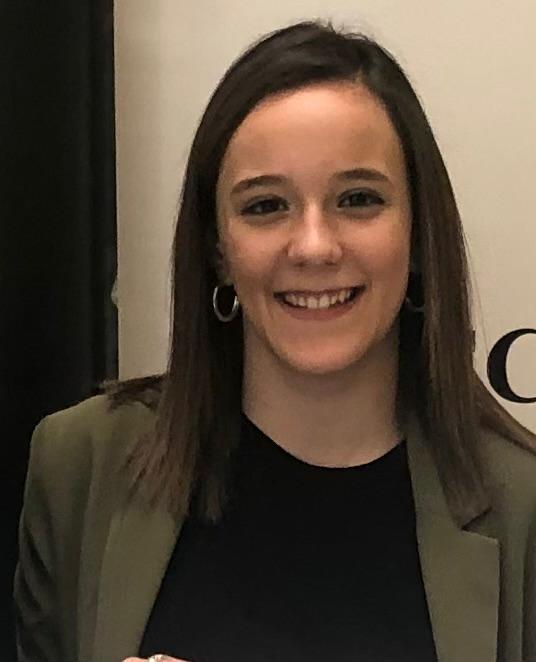
Featured Member: Corpus Navalón-Guzmán
Featured Member shines a spotlight on the diverse research interests of, and the exciting projects undertaken by, those affiliated with the Cultural Memory Studies Initiative. In this eighteenth instalment of the series, we speak to Corpus Navalón-Guzmán ,an FWO Junior Postdoctoral Fellow at Ghent University, whose current research examines the intersections of queer experience and climate trauma in contemporary Anglophone literature. In this interview, she reflects on the intellectual journey that led to her work on queer trauma, discusses her recently published monograph on queer childhood, and introduces her current project on “queer climate trauma.” She also talks about developing and teaching a new course on LGBTQIA+ narratives at Ghent and reflects on possible directions for her research.
So, your research looks at cultural representations of queer trauma. How did you arrive at this topic? What about it interests you?
I think this is one of the questions I’ve gotten the most! I’d like to tell you about a fascinating story, but the truth is that it is simple. Call it curiosity, or just plain interest in all things queer, I’ve always been drawn to the LGBTQIA+ world. Looking back to my university years, I remember always choosing to write essays on films like Milk, Bend it Like Beckham, and even impersonating some works by Oscar Wilde myself in the literature seminars. I was a sucker for reading these stories through canonical concepts both in cultural studies and queer theory, including hegemony, Barthes’ naturalization, and even Butler’s performativity. While everyone was choosing more conventional movies to apply the famous heuristic tools of cultural studies, I felt the need to immerse myself in the lesser known and unvoiced stories that these narratives portrayed.
At the same time, I have always been captivated by the mental processes of human beings, and particularly the way they are spoken about in literature. The movement from stigma to liberalization that mental health illnesses have undergone in the past sixty years has been extremely interesting to see in literary depictions. You can almost chart the changes in how, for instance, a depressive episode is narrated depending on when the book was written. And, widely thinking about the topic of my PhD, I decided that it would be nice to mix the three things that I was mostly interested in, meaning the LGBTQIA+ community, mental health and the literary enactment of these two things. On paper that sounds neat, but for a while it just felt like I was trying to combine three separate obsessions I couldn’t quite put together since I didn’t yet have a conceptual link that could hold the three in the same frame without the work turning too pathological.
But all of this was solved when I stumbled upon Ann Cvetkovich’s monograph, An Archive of Feelings —shoutout here to my PhD supervisor— and the concept she proposes there: queer trauma. She focuses on unearthing lesbian psychic wounds in order to make them central points for discussion around queer and trauma cultures. I was really drawn into her insistence that trauma doesn’t have to be spectacular to matter and that the quiet, ordinary, cumulative kind deserves just as much scholarly attention as the dramatic kind. She’s explicitly working against a clinical model that treats trauma as a diagnosable event, and instead proposes an archive built from cultural texts, affects, and everyday practices. Clinical approaches, and even much of trauma theory’s own vocabulary, Cathy Caruth’s, for instance, weren’t really equipped to look at these sorts of practices. That reframing gave me permission, in a way, to take the smaller, less obviously “newsworthy” queer stories I’d been drawn to seriously, and to treat literature itself as the site where this kind of diffuse trauma gets registered.
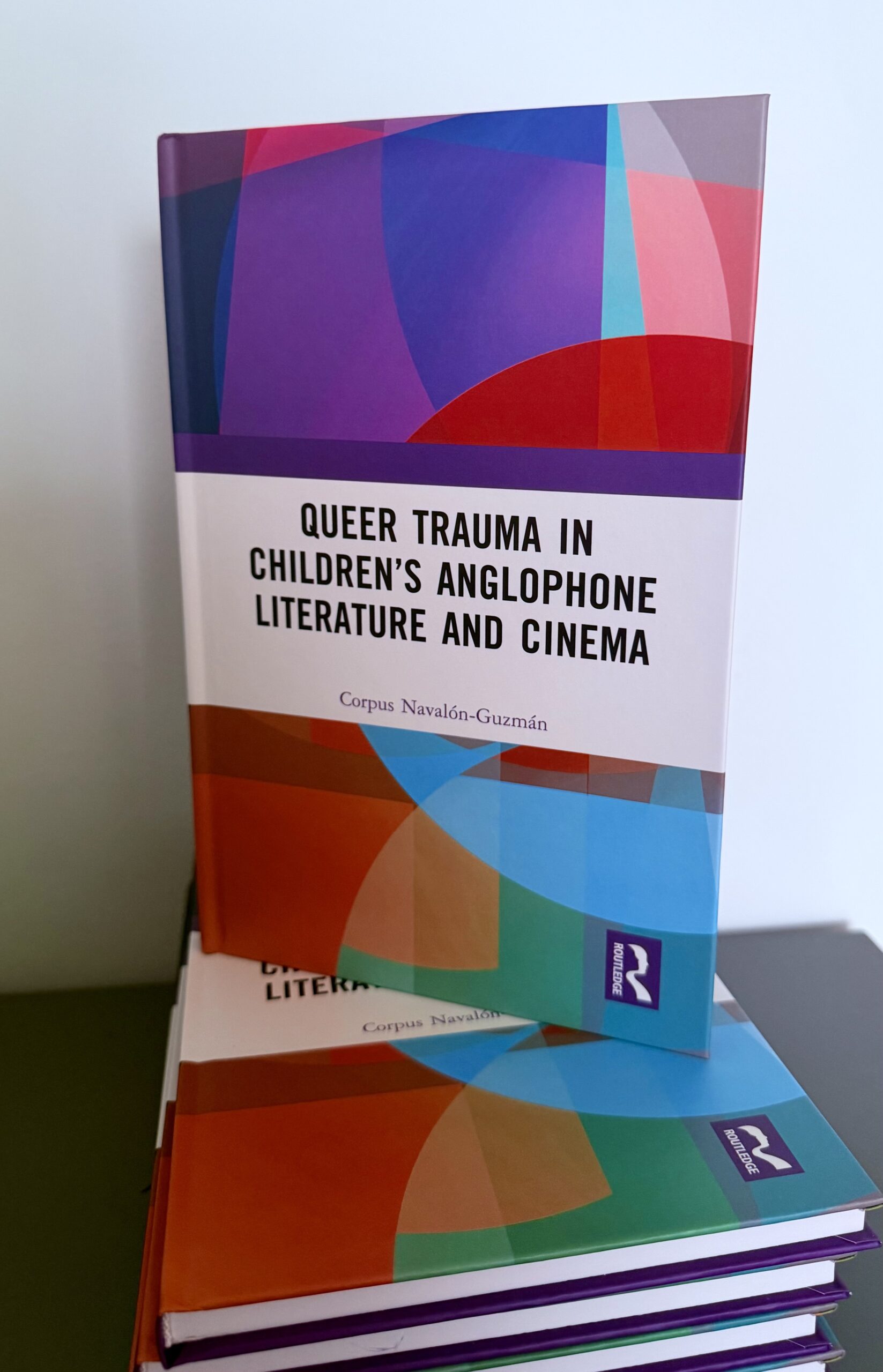 Some of the work from your PhD project has recently been published as a book with Routledge – congratulations! Queer Trauma in Children’s Anglophone Literature and Cinema examines how contemporary English-language novels and films represent trauma in queer childhood and adolescence. The book opens with a fascinating anecdote about the banning of queer books in recent years. Tell us about this. What do you think is the importance of this kind of research in the face of growing homophobia?
The decision to incorporate this discussion into my monograph was not incidental. While I was writing my PhD dissertation, from which this monograph emanates, I found myself extremely affected by an event that was happening in my home country, Spain. Since 2023, several Spanish municipalities governed by Vox (a far-right party, often in coalition with the mainstream conservative PP) have ordered that LGBTQ-themed books are removed from the children’s and youth sections of public libraries. I remember being genuinely baffled because I couldn’t believe why books that were so necessary, that gave visibility to LGBTQIA+ identities in schools, of all places, were being banned. It sounds a bit dramatic maybe, but I felt as if we were back to some earlier, much more repressive moment. And I felt obliged to talk about it in the dissertation, partly because the more I dug into the news around this, the more I realized it wasn’t just a Spain thing, as it was also coming from the States. Moreover, it had a very direct correspondence to my project not only because of the topic I addressed but also because one of the books I was exploring in my dissertation was among those banned, A Year Without a Name (2019). And looking at it from, I suppose, the scholarly side of the window, and really trying to understand how that would affect a queer child’s process of growing up freely, I just felt like I undoubtedly wanted to do something about it.
Interestingly, or frustratingly, when you actually dig into the rhetoric used to justify these bans, it almost never reveals itself as outright homophobia. It is filtered through discourses about protecting childhood innocence, or as a question of “age-appropriateness.” So, this framing became something I wanted to sit with intellectually, not just react to politically. There’s work by people like Kathryn Bond Stockton, Hannah Dyer, and Jack Halberstam that I found myself returning to a lot, which shows how “innocence,” when applied to children, isn’t a neutral category at all. Some children get to be innocent, and others, historically and honestly still now, don’t. So, when queer children’s books get removed from shelves in the name of protecting innocence, what’s actually being protected is a pretty narrow idea of what a child is even allowed to be. It reminds me a little of what Lee Edelman calls the “fantasy of the Child”, this figure of pure reproductive futurity that doesn’t really leave room for queerness at all. And I suppose what I try to do in the book, in my own small way, is push back on that by insisting that queer children existed then and exist now and were and still are living through forms of trauma generated by these kinds of acts. Literature that refuses to represent them isn’t protecting anyone. It’s just leaving the kids who don’t fit that fantasy to deal with it without any language for what they’re going through.
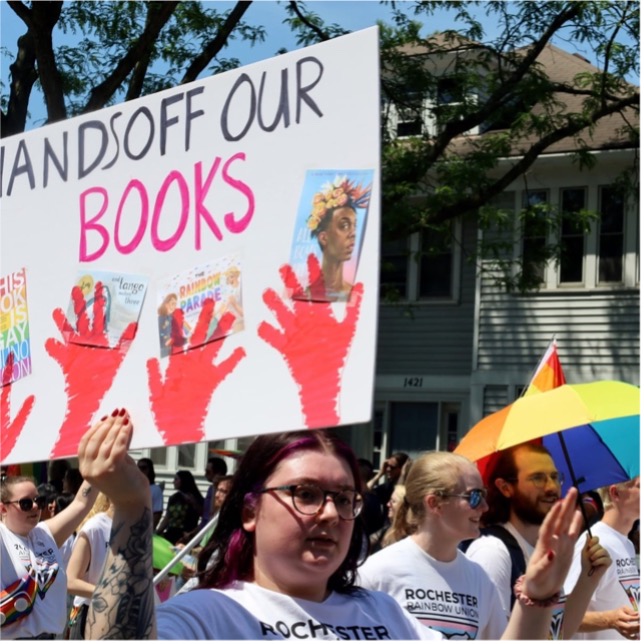
Photo credit: The Guardian
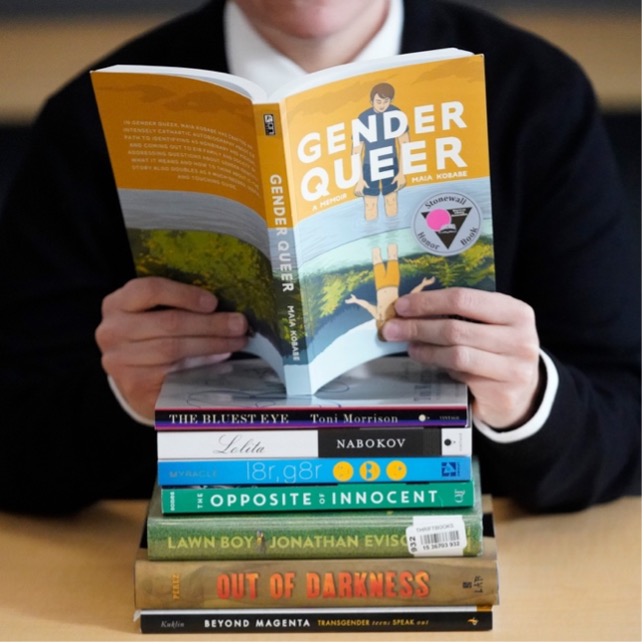
Photo credit: WGME
At UGent you are working on the FWO project ‘Queer climate trauma in contemporary Anglophone literature’ which examines overlooked texts and significant works produced between 2000 and 2020. How does this postdoc relate to your previous work on queer children’s culture? And what are some of the texts you are looking at as part of this new(ish) project? Are there any you think readers of this blogpost should check out?
Honestly, this project still feels a bit like a leap, even to me, and I mean that in a good way. I started working on it in earnest last year, and I’m actually still excited about it, which I think says something because four years into a PhD you sort of brace yourself to be sick of your own topic by the end. In many ways, this postdoctoral project is a natural continuation of my research into queer trauma and LGBTQIA+ childhoods, since I propose to take the concept to a very different area where, not coincidentally, I am starting to see some commonalities. Across my monograph, and really across the whole four years of the PhD, I was trying to trace the literary and cultural iterations of this form of insidious trauma that unfolds slowly, at the everyday level, and that creates a kind of never-ending wound for the queer community through constant stigmatization, rejection, and violence.
Unknowingly, or maybe not so unknowingly, the current ecological epoch is generating something quite similar, which a number of scholars have taken to calling climate trauma: “an ever-present existential threat” (Woodbury 2019, 5) about an impending environmental collapse that is unfolding slowly. I found a clear structural commonality between climate trauma and queer trauma, in the slowness and insidiousness of both, and I decided to take that as a starting point to explore how this new form of trauma plays out for members of the LGBTQIA+ community. The easy conclusion would be to assume it manifests exactly the way it does for heterosexual, cisgender people, but the truth is that it doesn’t. Emergency reports after catastrophes have documented how trans* individuals were denied shelter during Hurricane Katrina on the grounds of their gender identity. And for those who had already been expelled from home before the disaster even hit, the likelihood of experiencing the physical consequences of a climate catastrophe first-hand was even higher. So, what you get, inevitably, is climate trauma generated, and compounded, by microaggressions that unfold on a daily basis.
I noticed that even though activist groups were already naming this intertwined distress, almost no public media was echoing it, except, interestingly, the literary world. In my project I’ve curated a corpus of around twenty works that explore, from different angles, what I call ‘queer climate trauma’: this is my own attempt to hold both concepts together rather than treat one as a subset of the other. A couple of books I keep coming back to are Sim Kern’s Depart, Depart! (2020) and Rita Indiana’s Tentacle (2015). They sit in quite different genres, the former is more realist, closer to the trauma narrative, whereas the latter more speculative, and deliberately messy about time and causality. But both account for the psychic costs of being rejected on the grounds of queerness at the exact moment that rejection collides with a natural disaster. Formally, they both raise questions about how trauma narratives, historically built around a singular, locatable event, have to accommodate something as diffuse and non-eventful as climate change or queerphobia. That’s partly why I keep returning to Barbara Adam’s notion of environmental time, which resists exactly that kind of single-event temporality. I also keep returning to the sociological idea of ecological myopia, that when a threat is vast enough in scale, the bigger and more urgent it gets, paradoxically the easier to ignore other related issues become.
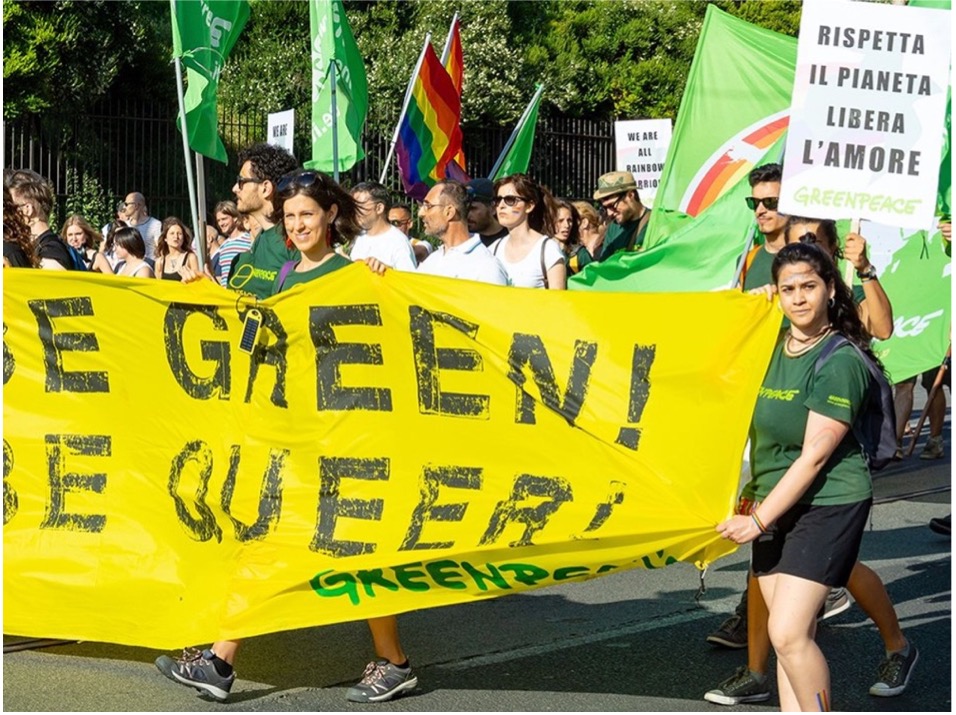
Photo credit: Greenpeace
As well as publishing and researching you have been doing a lot of teaching recently, including putting together your own course on queer fiction. How have you found the process of assembling this course and what are your early reflections on teaching it?
Yes! I’m also extremely grateful that this project has brought me to Ghent, and that I’ve been able to design a course I wish I’d had as a student back in the day. When I was given this opportunity, I knew that I wanted to do something related to queer theory, because while it is a tangential topic in many of the courses proposed here at Ghent University (I even guest-lectured one session on queer trauma at Prof. Craps’ seminar “Words for Wounds: Narrating Trauma”) a full queer lens was lacking. I believe this is not for lack of interest! At the same time, this lacuna is actually happening against a backdrop where humanities degrees and gender-related subjects are actively being cut from curricula by those in power, so carving out space for something explicitly queer feels like a small act of resistance.
The process of putting this course together, and doing something different at the same time, has been a rollercoaster! Sometimes I doubted whether the choices I’d made in terms of primary literature were genuinely interesting to students, and whether they’d offer useful insights to nurture their knowledge on the topic at the same time. I also didn’t want to just do a greatest-hits tour of queer literature, because I wanted each week to be doing something specific theoretically. But after exhaustive feedback from colleagues and friends, I think I found something I could start working with. For instance, I’ll be teaching queer temporalities through The Argonauts (2015), queer posthumanism through Frankissstein (2019), and even queer childhood through the film adaptation of Justin Torres’ novel, We the Animals (2018), and I’ve tried to build the syllabus so that each of these speaks back to the others a little. One of the deliverables of the course is a digital zine based on the students’ critical and creative reflections on some of the theories discussed in class. I liked the idea of a format that’s a bit more playful and DIY than a standard essay, partly because zines have their own history in queer and feminist cultural production. I can’t wait to see what students end up producing!
So far, my experience has been very rewarding. Students have welcomed the course very positively, and the discussions we’re having showcase a genuine interest in the topic, which is encouraging! Something that is surprising me a lot is how willing students have been to bring their own reading angles and experiences into the seminar room. That is something that I don’t think would happen as easily in a more conventional literature course!
Lastly, what is next for you after the FWO postdoc? Are there some other topics that you would love to work on?
A really nice question to end this interview! Though I have to be honest, I still don’t have the ability to see the future, so take everything I say here with a pinch of salt! I hope my next steps keep building on what I’ve already started, of course. I see myself with a permanent position somewhere in Spain (fingers crossed), expanding the course I’ve designed, and maybe teaching something a bit less ambitious but equally productive at the BA level.
As for what comes next research-wise, I genuinely don’t know yet. But something that’s been on my mind lately is Sarah Ensor’s recent book, Queer Lasting: Ecologies of Care for a Dying World (2025) and some of the ideas she puts forth, like that queerness has always held ending and persisting together, and that some of the clearest models we have for living without a guaranteed future came out of the AIDS crisis. I find myself thinking about that alongside queer aging and how little contemporary fiction there is that puts an older queer protagonist at the centre and takes their experience of climate change seriously as its own kind of trauma, on top of everything that generation has already survived. Most cli-fi either skips the elderly altogether, treats them as background or a symbol of a world ending rather than someone who’s already lived through one ending and now has to face another. And climate change is traumatic for older queer people in specific ways. For instance, a lot of them rely on chosen family rather than biological family for care and chosen family networks are exactly the kind of informal support that collapses fastest during a disaster.
I don’t know if that’s where I’ll actually end up. But if it is, I think there’s something genuinely hopeful in it, too, because the same generation carrying all that precarity is also the one that already knows how to build community and care when nothing is guaranteed. That’s not a small thing to have, especially now. So even in the middle of writing about trauma, which is what I’ve done for years at this point, I like the idea of ending up somewhere that’s also about hope and resilience.
